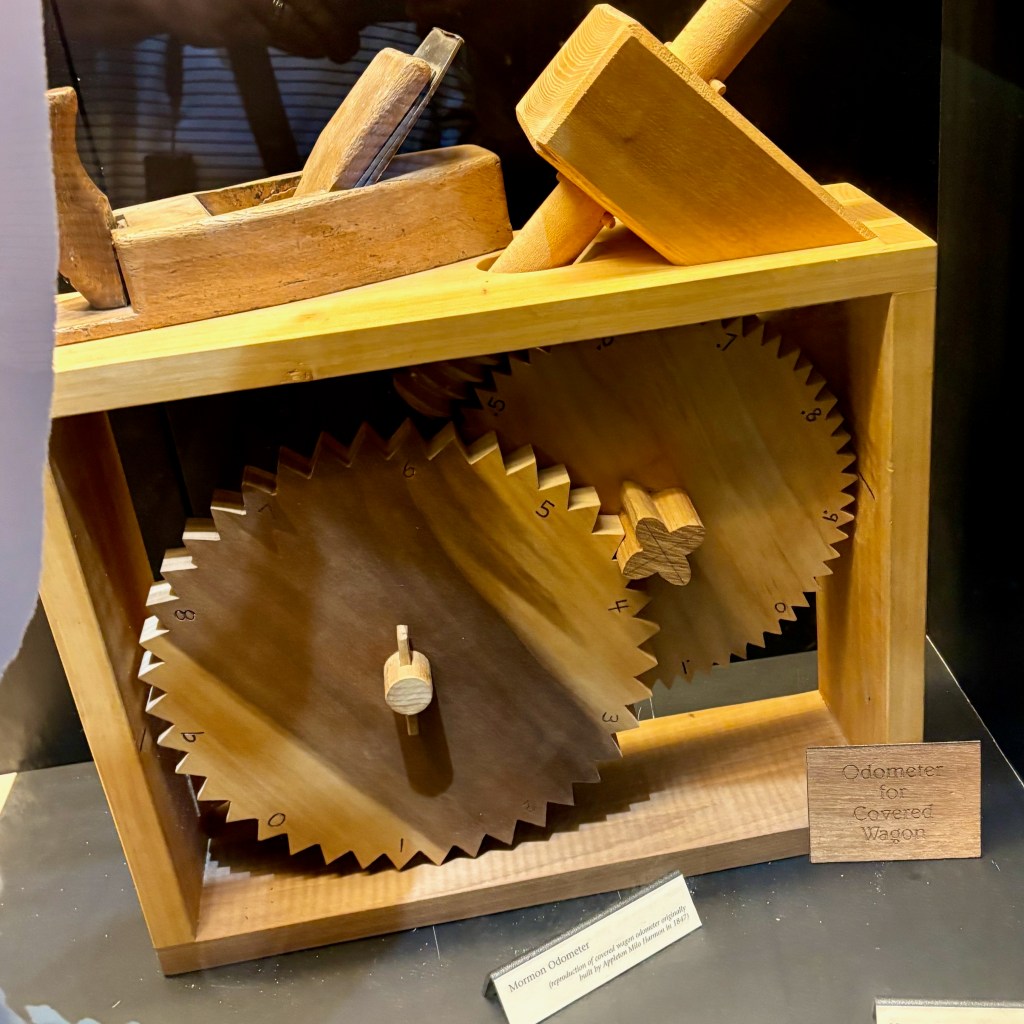
Reading through hundreds of Oregon Trail diaries at the Merrill J. Mattes Research Library at the National Frontier Trails Museum in Independence, Missouri — as well as online and in published volumes back home — one thing kept hitting me. Nearly every diary entry noted how many miles the journal keeper had traveled that day. Given the analog nature of covered wagons, I wondered, how did they know? Was some poor soul counting wheel revolutions?
Turns out, covered wagons had odometers — a set of wooden cogs and wheels attached to a wagon wheel that tracked revolutions. The first “roadometer” on the Oregon Trail was the creation of Mormon pioneer William Clayton in 1849. Perhaps he was inspired by Benjamin Franklin, who made one in the 1760s.
But odometers date back to ancient times. Roman architect Vitruvius, for example, designed one in 15 BCE to track distance using a chariot wheel (of course) and cogs that kept count by dropping pebbles into a receptacle. Before I get too distracted and go down a rabbit hole on Ancient Roman units of distance — a mille passus or 1,000 paces — look up there! 👆 That’s a covered wagon odometer on display at Fort Kearny State Historical Park in Kearney, Nebraska.
 Jackie Burrell, Writer
Leave a comment