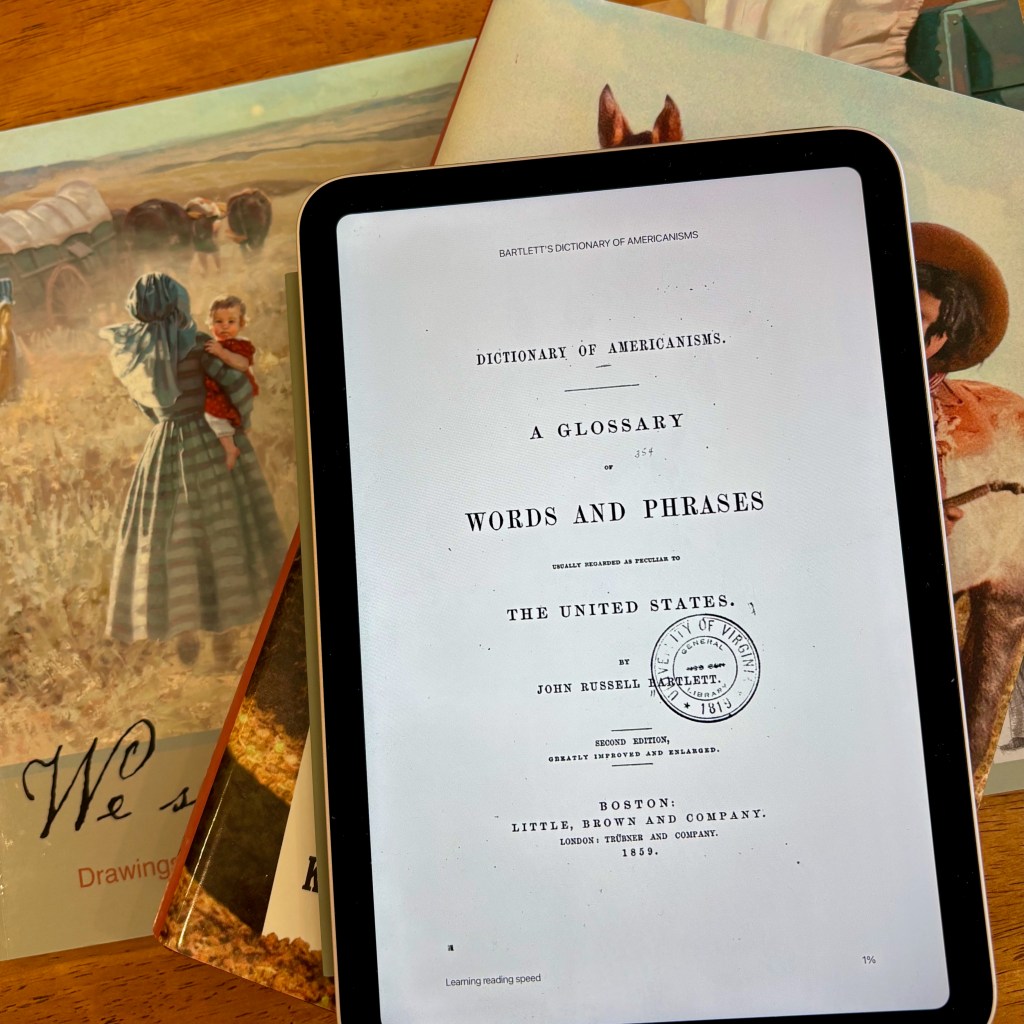
I’m deep into old words these days — Gold Rush and Victorian-era slang, 19th century dictionaries and troves of etymology treasure. I lost an entire afternoon to Merriam-Webster’s fantastic Time Traveler the other day. It sorts words by the first year they were used in print, whether it’s 1613 (alimony, dungaree) or 2025 (vibe coding). As you might expect, some words are rarely used anymore. Surely prescient Brits dabbling in haruspication (1871) could have foretold that word’s fall from favor. But no. Even the planchette (1860) from Ouija™ was like, “Haruspi-what? No.”
Some words should make a comeback, though. Writing historical fiction makes that possible, though linguistic detours can be risky. Favonian (1681), for example, is tempting, should we wish to describe the warm and gentle qualities of the west wind in a way that distracts readers from plot and characters and makes this whole book-writing endeavor moot. Merriam-Webster even offers rhymes for Favonian — hello, Baconian (1791) — in case you’re a writer of odes. (Sadly, Baconian refers to the Francis-Bacon-was-Shakespeare theory and not crispy breakfast deliciousness. Although Bacon writing “Hamlet” has a certain appeal.)
I know this sounds like one giant rabbit hole of procrastination, and you would not be wrong. But as it turns out, our idiom-heavy language was even more so back in 1849 on the American frontier, which is the period I’m supposed to be researching. If you squirm over modern language — it’s a whole vibe, I know — wait’ll you hear these. It’s going to be some pumpkins. You’re going to see the elephant. Not an elephant. The. Elephant. (It means — never mind. Read on.)
So I’m trying to be selective in my slang choices. Absquatulate is great, and it takes but a moment to explain its get-outta-Dodge meaning. (An 1849 Dodge equivalent, anyway.) No explanation necessary for reckon and sarsaparilla. But there are certain, period-appropriate things my 1849 characters will not be saying in 2026, because however awesome the phrase once was, it takes so long to explain “acknowledge the corn” (1828), the reader will lose track of the suspects and focus only on the hogs. It’s so good, though. Here you go:
Acknowledge the corn: A confession or admission of a misdeed after you’ve been caught, the phrase originated during a highly amusing congressional argument on tariffs. (Who’d have thought?) It was 1828, and Pennsylvania congressman Andrew Stewart was unhappy about exports flooding in from western states, such as Kentucky, Indiana and Ohio. Those don’t sound particularly west-ish now, but Missouri, the then-newest state, was as west as this country got.
Western states, Stewart said, were trying to sell their “haystacks, cornfields and fodder” in Philadelphia and New York. Stewart’s counterpart, Charles Wickliffe, objected, saying his fellow Kentuckians weren’t sending haystacks or cornfield — preposterous! — to the east, merely mules, horses, cows and hogs. Stewart’s argument: By feeding $100 worth of hay to a horse, “you just animate your haystack and get on top of it and ride off to market … You put 33 bushels of corn into the shape of a hog and walk him off to market.”
According to a recounting in an 1890 edition of the Democratic Banner, “At this point in the debate, Wickliffe sprang to his feet and exclaimed, very hurriedly, ‘Mr. Speaker! Mr. Speaker! I acknowledge the corn.’”
 Jackie Burrell, Writer
Leave a comment