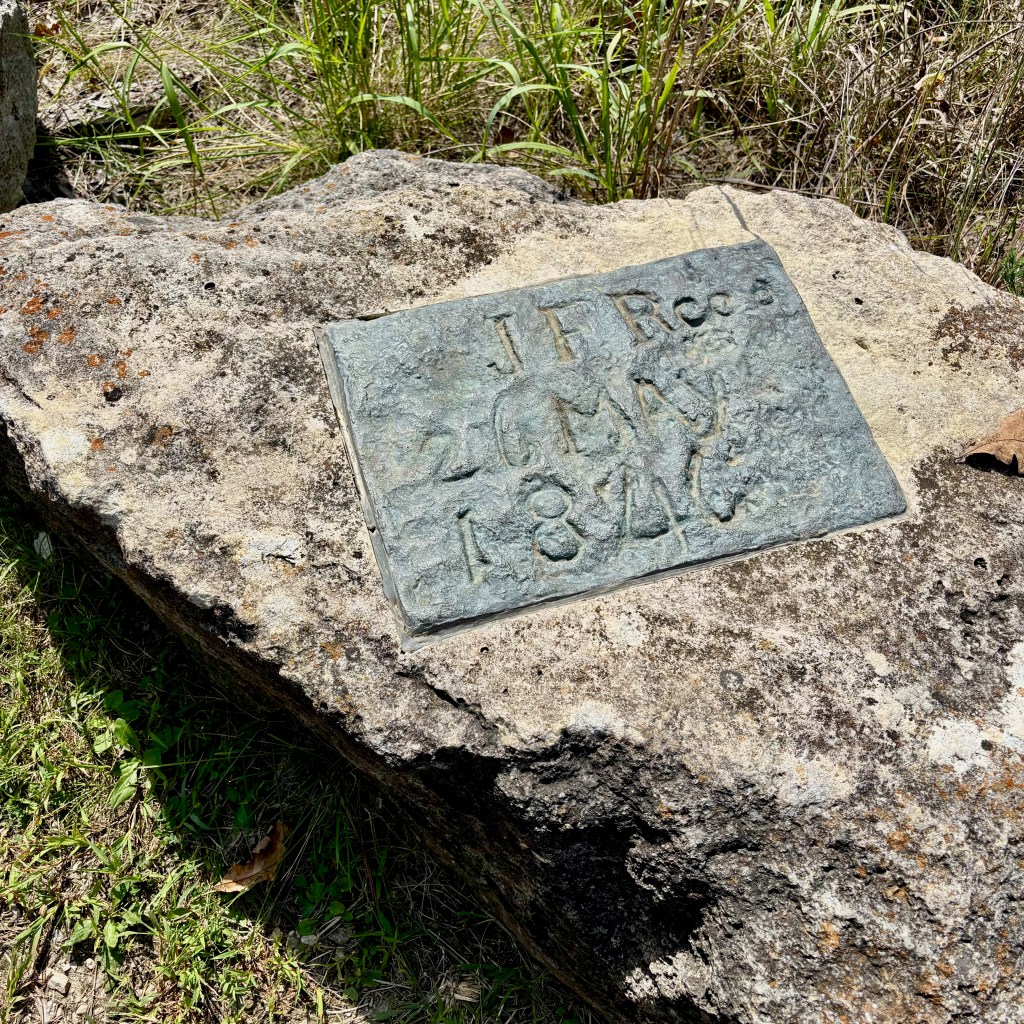
Spray paint tags on urban walls. Inky scrawlings in restroom stalls. You thought those were modern problems? Oh, no, no, no. The Oregon Trail is covered in graffiti. Those pioneers etched their names and initials on anything that didn’t move. How do you think Wyoming’s Names Hill and Register Cliff got their names? You can still see Donner-Reed Party autographs carved into the boulders at Alcove Spring in Kansas. Thousands of emigrants cut their initials and I-was-heres into the massive granite expanse of Independence Rock in Wyoming.
It wasn’t just pioneers. Explorer William Clark of Lewis and Clark expedition fame etched his name at Montana’s Pompey’s Pillar in 1806 and named the towering sandstone bluff after Sacagawea’s baby son. (Clark’s name is still there now. The charming “Pomp” story lives on in his journals.) Turns out, the expedition announced its presence in the wilderness by similar means at least 14 times, branding beech trees and chiseling names into buttes and bluffs, as they explored. Vandalism or communication?
That 21st century question makes no sense in 1806, not when you’re exploring 8,000 miles of wilderness and getting lost is part of the job. You can’t exactly breadcrumb it. And those branded beeches signaled the spot where Clark & Co. hid their red pirogue, which sounds like a tasty Eastern European dumpling but is actually an open boat shaped like a large canoe. Essential transportation, in other words.
I’m not condoning vandalism or the torture of trees, but the practice of engraving your name on things that are not yours to adorn is not only ancient, it’s complicated. Sometimes a name is just a name or a declaration of presence. It’s a few bawdy boasts on a Greek structure, circa 500 B.C., perhaps, or a “Gaius Pumidius Diphilus was here” (yes, really) on a wall in Pompeii 150 years before Vesuvius erupted. But when Napoleon’s soldiers carved their names in Ancient Egyptian temples in 1798, that potent act of disrespect announced the arrival of a would-be conqueror. (Who lost, btw.)
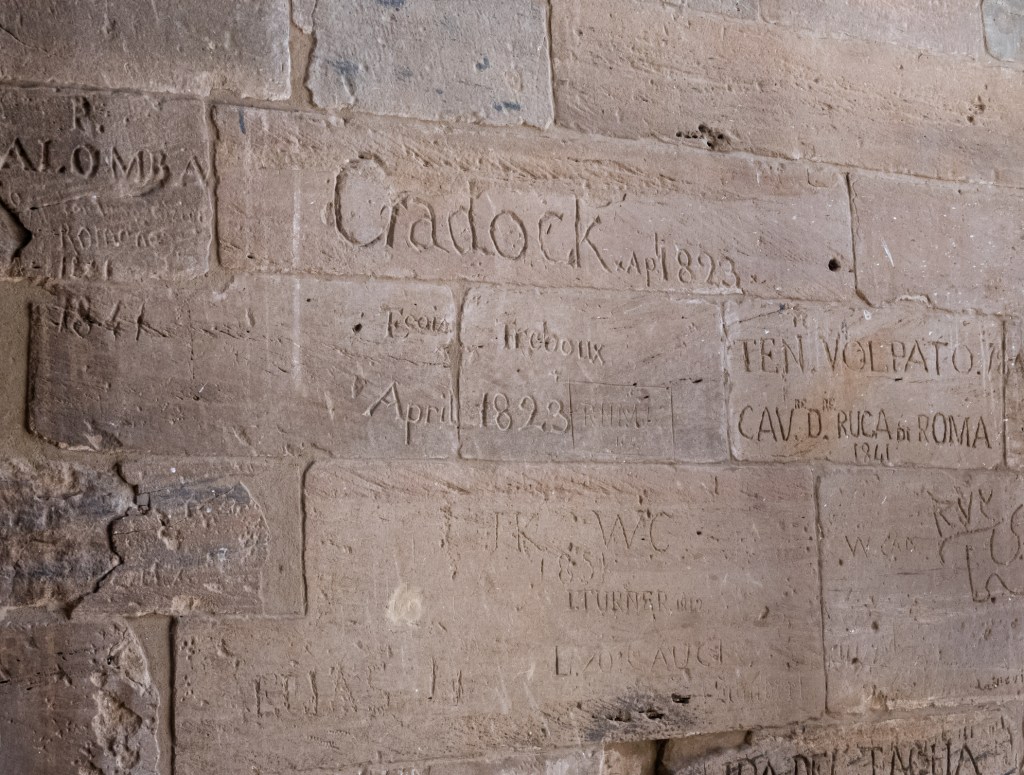
Who knows what the 19th century tourists were thinking when they followed suit and carved “L. Politi, 1819” and “L. Bradish, 1821, of NY US” into the Nubian sandstone of Egypt’s Temple of Dendur near Aswan. Perhaps, “I am here … desecrating another culture’s ancient treasures.”
You can see the graffiti for yourself at New York City’s Metropolitan Museum, where the temple has enchanted more than a hundred million visitors over the last half century. The temple was a gift from the people of Egypt. (Not an Elgin Marbles-style grab, although the Met is not immune to charges of looted acquisitions. The museum has repatriated or restored nearly 200 looted antiquities in recent years.)
There’s a very fun NPR story (2013) that includes L. Bradish, the New Yorker who chiseled his name in 1821, only to be outed when the temple arrived in his home town more than a century later. That’ll teach you to vandalize ancient temples, the witty NPR writer concluded. Of course, Bradish was long dead by the time karma came calling in 1978, and I’m not sure he’d have cared anyway. He became president of the New York Historical Society 30 years after his Nile adventures, so the optics would not have been great – not now, anyway. But I suspect a time-traveling 1821 Bradish would have gone to opening day of the Dendur exhibit and chortled, “I was here!” The 1850s Bradish might have done as well. Bradish knew about Independence Rock by then. Everyone did.
Today, we consider the desecration of artifacts and the carving of names into sandstone temples and granite outcroppings appalling. I would never. You wouldn’t either. But in the eyes of 19th century pioneers and explorers, that graffiti was proof of life. The celebration of accomplishment. A message to the family and friends who might follow them across plains and prairies and perilous paths: I was here. And Independence Rock, where the names of 5,000 pioneers are carved in stone, engraved upon history with chisels and grit, is a Wyoming State Historic Site and National Historic Landmark. Do not even think about adding your name. If you want to say that you, too, were here, we use Instagram for that.


Leave a Reply