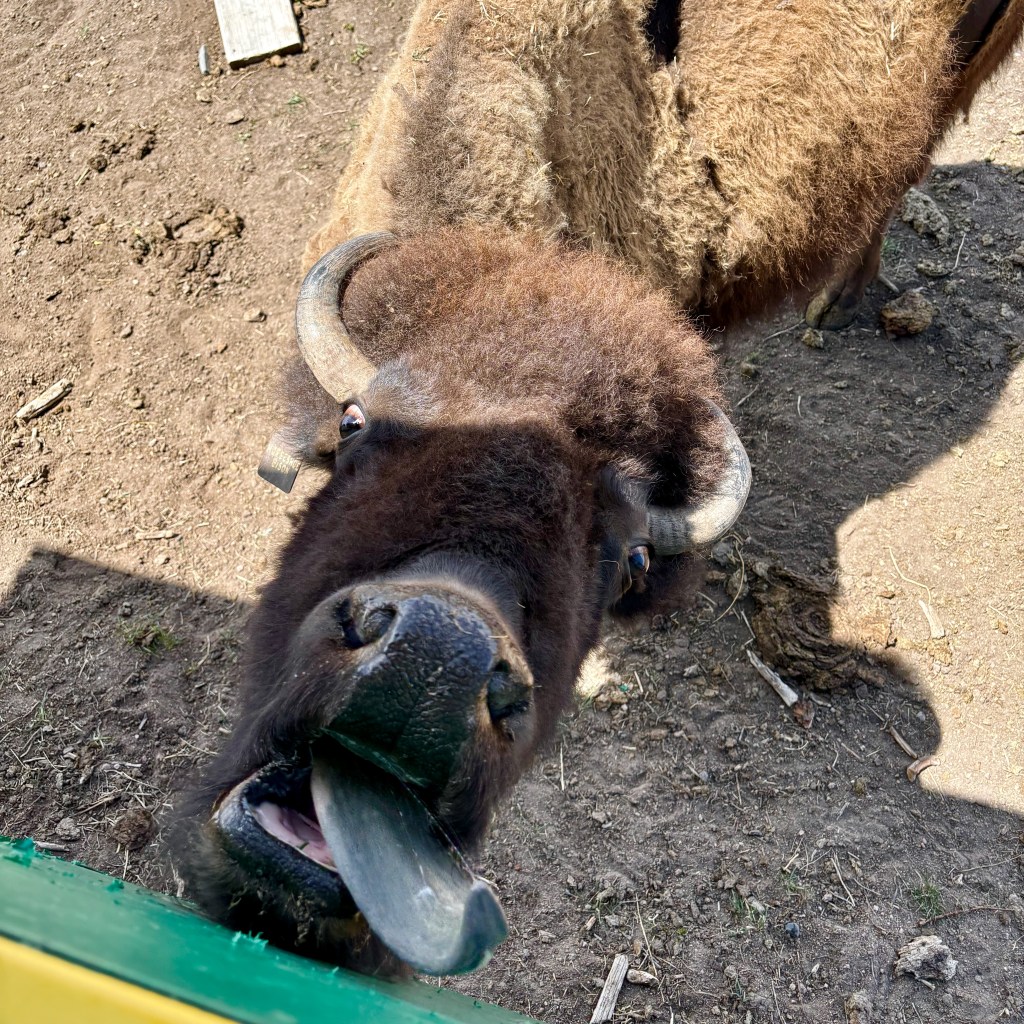
Turns out that tame hillside I saw online is terrifyingly perpindicular. The stony landmarks I dismissed with all the airy contempt of a 21st-century snob are totally awesome. And bison have blue tongues. Who knew?
See, here’s what separates writers from AI. We may share a great fondness for em-dashes — you know, the double-length punctuation marks used to show a sudden departure of thought, a halted exclamation, a sly aside. But human writers don’t churn out hallucinations or make things up — other than the plot and characters for novels, of course. The setting, the history, the facts are real. We research, we fact check, and we ignore Google images and go look at that steep hillside for ourselves. I do, anyway. Turns out Google Images was so wrong. Windlass Hill is terrifying even from the halfway point. I cannot imagine taking a covered wagon down that slope. Also, despite the windlass name — which came much later — no one used windlasses here. Pioneers lowered those wagons down the slope with rope and sheer grit.
As for those blue bison tongues? They’re real. I would’ve had no idea, if I hadn’t gone to Wyoming, shlepped out to a bison ranch myself and fed those magnificent creatures, their blue tongues curling around thick pellets of honey-bound grain goodness.
Misinformation is not new, of course. Even Oregon Trail diaries refer to the great herds of “buffalo” on the plains of what is now Kansas and Nebraska. The U.S. Mint cranked out American buffalo nickels from 1913 to 1938, and issued yet another American buffalo coin this year. That’s branding, folks. There are no buffalo here. These animals are bison — magnificent creatures native to North America and Europe with large shoulder humps, shaggy brown fur and relatively short horns. Buffalo are a different species entirely.
Blame 16th-century French explorers for the confusion. They spotted their first bison on the North American plains, thought it looked like a curly-haired, short-horned, shaggy version of Asia’s sleek, humpless water buffalo and Africa’s equally sleek, long-horned Cape buffalo and said, “Tiens! Le Boeuf sauvage! We shall call them Buffelo!” (No, seriously. That’s where the name comes from.)
It wasn’t until the late 19th century that anyone gave heed to scientists’ exasperated throat clearings and gave bison their own species name: bison bison. I suspect whoever came up with the name for the subspecies had had it with buffalo marketing efforts, too, because the animals that roam the Plains are bison bison bison. They have blue tongues. Blue blue blue.


Leave a Reply