Can we talk about Mrs. Winslow’s Soothing Syrup?
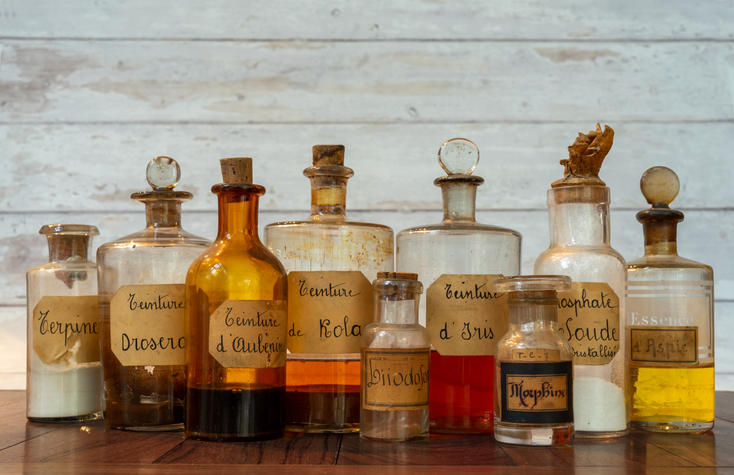
Humans have always sought ways to alleviate pain, whether it’s a headache, cramps or something more severe, like a severed limb. Got gout? Ancient Roman physician Scribonius Largus suggested applying an electric torpedo fish to the painful spot. Aches, pains, racking coughs? Scribonius and centuries’ worth of physicians, apothecaries and healers favored opium for that. So did the Bayer Co. which introduced heroin in 1898 as a marvelous new cough suppressant and pain reliever without the problematic addictive properties of, uhhh, morphine. (It took 15 years for them to realize that wasn’t the case.)
Do we need a quick primer on opium, morphine and laudanum, before we get to the snake oil quackery and the guaranteed-to-make-your-head-explode saga of Mrs. Winslow’s? Skip to the next part, if you already know all about opium. (I won’t judge. I’ll assume your “milk of the poppy” familiarity comes from Game of Thrones.) For millennia, scientists and healers have known the poppy plant and its milky sap possessed pain-killing properties. Morphine was isolated in 1804. Codeine followed in the 1832. Heroin was synthesized from morphine in 1898. And laudanum, a 10 percent solution of opium in alcohol, hails from the 16th century, when the original ingredient list included gold dust and crushed pearls. Within a century, the tincture had gone a bit less luxe with saffron, cinnamon and cloves — expensive spices, true, but not GOLD. By the 19th century, laudanum was available everywhere.
Looking back on the wild unregulated world of American patent medicines, snake oil salesmen and assorted quackery is sobering. No one was dosing fussy babies with electric torpedo fish, true. They were doing it with laudanum’s syrupy cordial cousins, opium-laced tonics and soothing syrups that promised to calm colic, teething pains and infant fussiness.
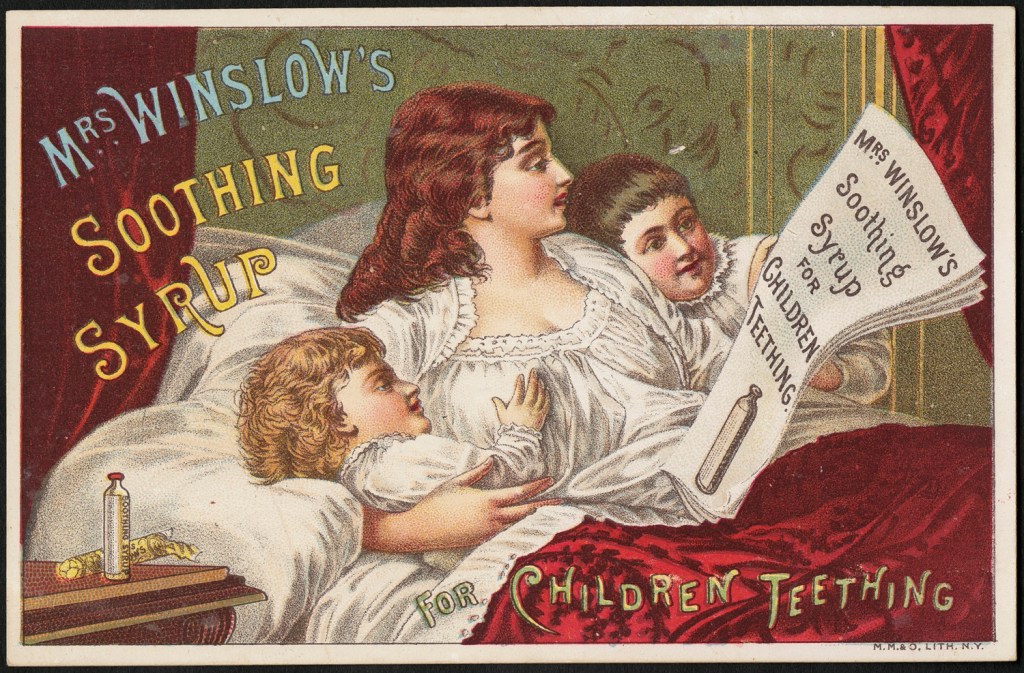
An image of pink-cheeked domesticity, complete with young mother and happy babies, adorned the labels of Mrs. Winslow’s Soothing Syrup, one of the most notorious of the offerings. The patent medicine arrived in American and UK markets in the 1840s, courtesy of Jeremiah Curtis, the son-in-law of the real Mrs. Winslow, a pediatric nurse who laced her eponymous syrup with a whopping 65 mg of morphine per ounce. The rest was alcohol and flavorings. None of that was on the label, the advertisements or other merch — just beaming babies and promises. Patent medicines didn’t have to declare their ingredients back then.
No one knows how many children died because of the syrup, but even the lowest estimates are in the thousands. Curtis was selling 1.5 million bottles per year by 1868, and the syrup was immensely powerful. Babies under six months were not supposed to have more than two or three drops of laudanum. Mrs. Winslow’s delivered the equivalent of 20 drops of laudanum per teaspoon.
I’ll bet you’re thinking, “No prob. How hard can it be to measure 1/10th of a teaspoon?” The question assumes you knew that’s what the dosage should be. But a 1915 ad for Mrs. Winslow’s that ran in the Maryborough Chronicle in Queensland, Australia, offered these recommended dosages: “For a child under one month old, 6 to 10 drops; three months old – half a teaspoonful; and six months old and upwards – a teaspoonful three or four times daily.” (What’s not clear is whether the rules that applied once the U.S. Food & Drug Act was passed in 1906 — Mrs. Winslow’s had to publish its ingredients, and the company removed the opiate and the word “soothing” — applied in Australia, too.)
But even a year after the American Medical Association categorized the syrup as a “baby killer” in its 1911 publication of Nostrums and Quackery — amazing title — you could still find the original formulation on store shelves in the U.S. Mrs. Winslow’s was sold in American markets up until 1930.
As a mother of four, including one baby who had croup and all four who had teething pains and fussy spells, may I just say: holy hell.


Leave a Reply