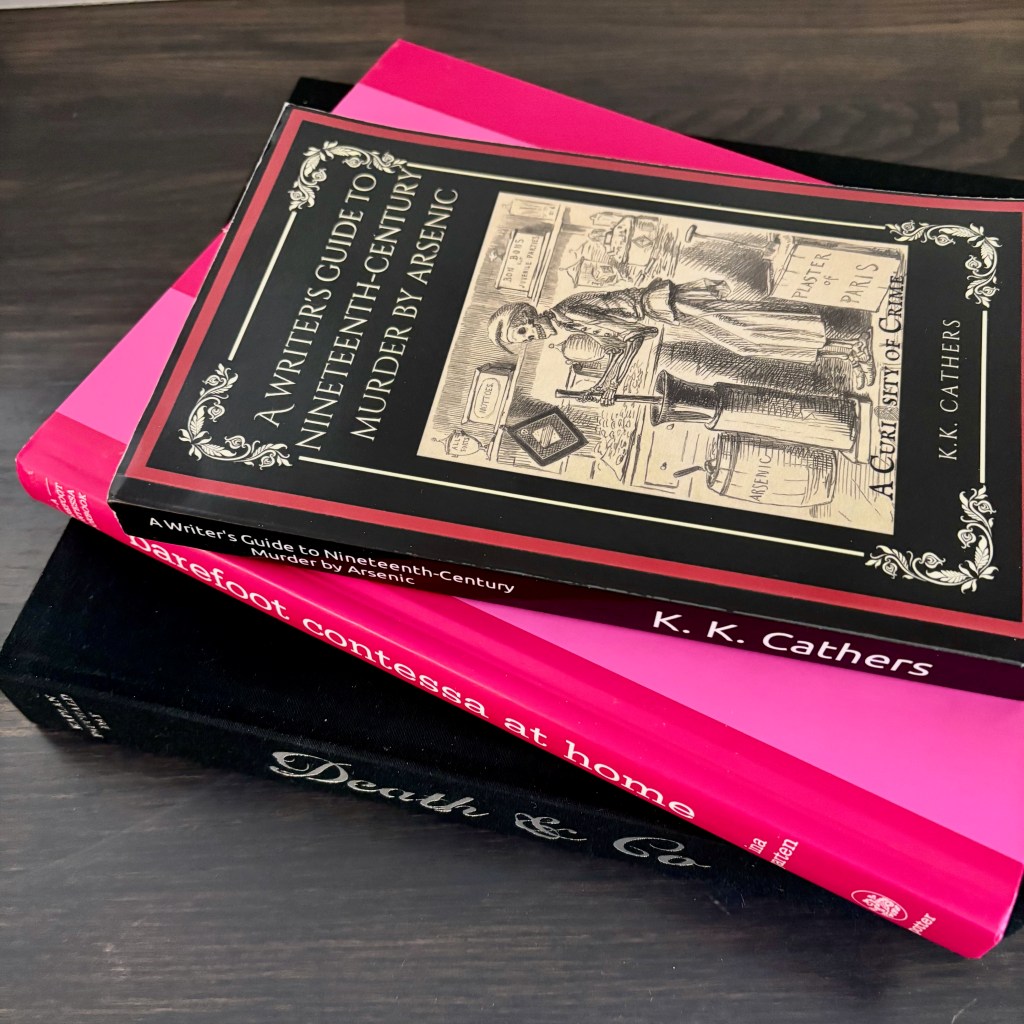
When planning a dinner party, it is wise to consider the dietary needs of the guests, as well as the inclinations of the host. Which brings me to K.K. Cathers‘ A Writer’s Guide to Nineteenth-Century Murder by Arsenic. I don’t know why you’d resort to that Agatha Christie favorite, cyanide, when there was arsenic in pretty much everything, even the wallpaper. Especially the wallpaper.
Kerry Cathers recently did a talk on 19th-century forensics and crime scenes, hosted by Mavens of Mayhem, the Upper Hudson chapter of Sisters in Crime. That clause was poorly placed. The talk was hosted by the mavens, not the crime scene, although you never really know with writers, do you? They sit across from you at dinner, making pleasant small talk, but they’re thinking murderous thoughts all the while.
The weather’s been lovely, but will Mrs. Patmore’s sprightly chicken piccata mask the arsenic au jus?
It will. Arsenic’s virtually undetectable in hot food and drink, says the delightfully thorough Cathers. Let the arsenic-laden goulash or risotto cool, though, and the metalloid precipitates out, leaving your guests puzzled by the gritty texture of an otherwise tasty dish. Use that information responsibly, people!
I’d known there was no CSI in 1850s America. No Horatio Caine whipping off his sunglasses and spouting cringey one-liners. No bustling, gadget-filled labs analyzing GSM, blood spatter and other “contributions.” That comes later. But there wasn’t nothing. If you were a detective in the 1830s, you were matching bullets to guns, identifying hair strands (human vs. Edgar Allan Poe orangutan, anyway) and making plaster casts of boot prints. And the trope of the amateur sleuth strolling through a crime scene and helping herself to clues? Legit. People did that.
Cathers is working on a series of reference books aimed at the murder-committing crowd — historical fiction writers, I mean, not felons. Her 252-page writer’s guide to arsenic (published in 2022, A Curiosity of Crime) includes all the how-tos a villain (or author) needs, from where to source the toxic substance to how to administer it. The former is easy. Your friendly town grocer stocked it, and you probably had some in your kitchen cupboard, leftover from the last time you sent little Mortimer Jr. to the mercantile with a shopping list. Look, it’s the toxic white powder in the unremarkable container next to all the other non-toxic white granules in also-unmarked containers. As to administering the poison, there’s always dinner.
Cathers’ appendices offer all sorts of helpful information, from historical case studies and prosecution and defense strategies to diseases with similar symptoms. Psst, if you’re looking to off that divorce-resistant fictional husband or a wealthy, childless great-uncle, a cholera outbreak is a great time for that.
But it’s the “arsenic in the world” list that has me reeling. It’s not just rat poison. Arsenic was used in everything from medicines to food coloring, candles, cookware and playing cards. It was infused in beauty creams, lathered on lickable postage stamps (!) and administered as an aphrodisiac. I’d rather get roses. Hold up. There was arsenic in 19th-century dried flowers, too.


Leave a comment