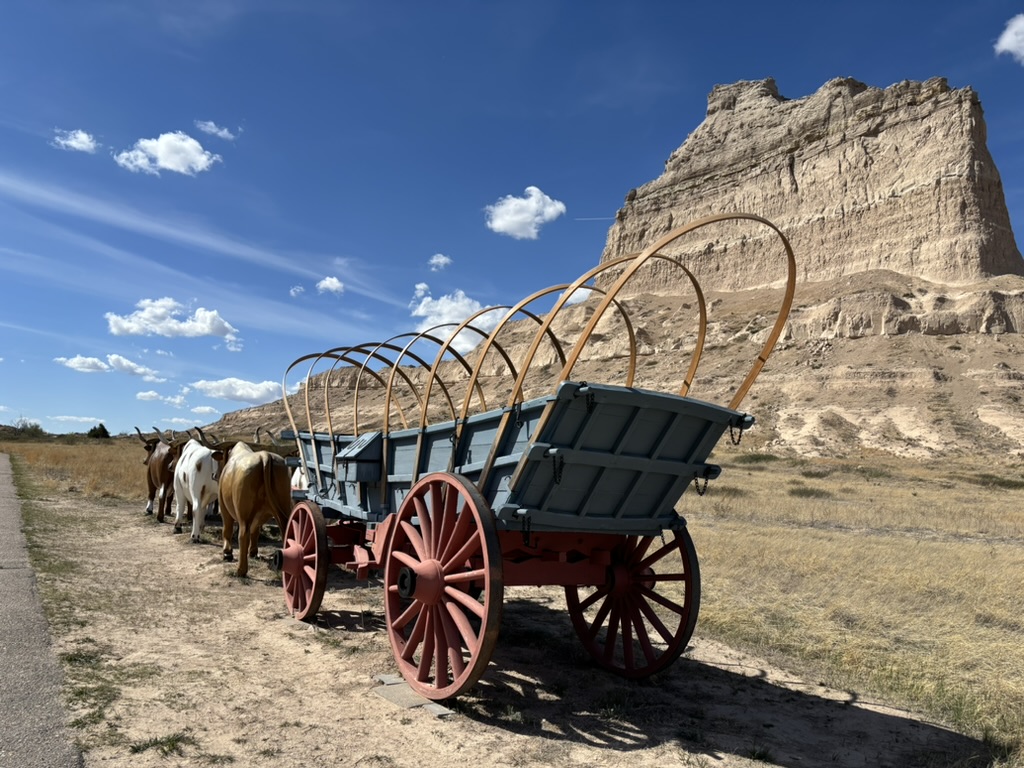
I suspect other people don’t take trip pics like I do. Oh sure, I’ve got grand vistas and gorgeous landmarks in my photo library. But anyone browsing images from my recent Oregon Trail research trip to Nebraska may wonder if I understand anything about how to frame a photograph. Yes, I’ve got some people pictures – my husband waist-deep in a wagon rut, for example, and nearly invisible halfway up Courthouse Rock. But I’ve also got quite a lot of … well, here, take a look.
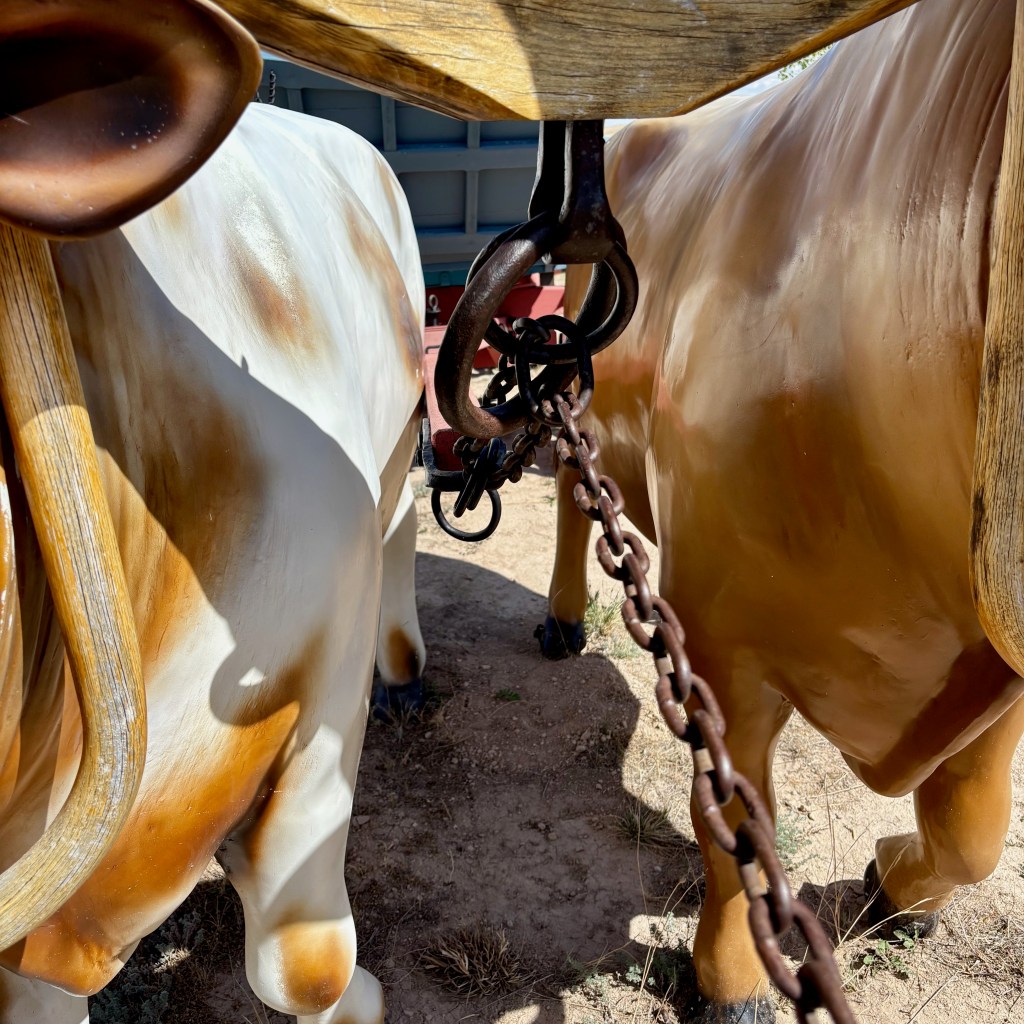
That, my friends, is the underside of a covered wagon at Scottsbluff National Monument, taken from the perspective of an oxen’s hindquarters. Or a writer squatting among life-size fiberglass oxen to see how this whole yoking/harnessing/chain thing works. (Yes, I could have taken notes, but isn’t this better? And thanks to the National Park Service display, I didn’t have to squat amongst cow patties, for which I’m grateful.) These particular oxen – let’s call them Julius and Octavius – are the wheel oxen, the pair closest to the wagon (the blue wall in the background), who provide the most control and braking power. The chain runs from the wagon tongue (the reddish piece in back) through rings on each yoke (yep, the wooden piece at the top of the image), allowing three pairs of oxen to pull a wagon laden with 2,000 pounds of supplies.
Julius and Octavius are joined in my fictional endeavor by Brutus and Cassius, steering the team in lead yoke, and Bright and Blue providing brawn in swing position. (“We can’t all be Roman leaders,” Henry, the equally fictional owner of my made-up oxen, points out. “Besides, better a Blue or a Bright than a Caligula.”)
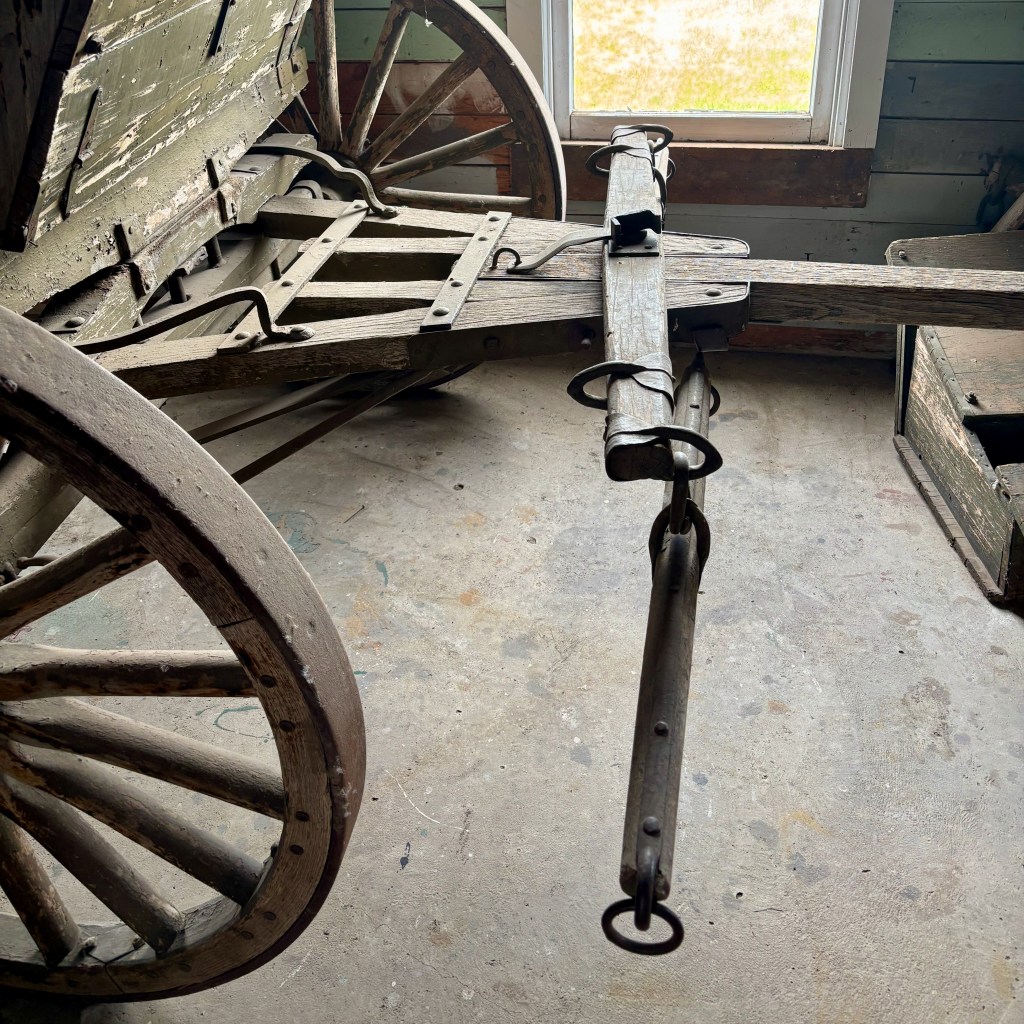
I was also intrigued by the concept of a king bolt (👇below), a small bolt of critical importance to wagon operation. You can’t turn a wagon without that pivot point. You can’t go anywhere. The king bolt, seen here at Fort Robinson, holds the wagon’s axle, tongue and hounds together.
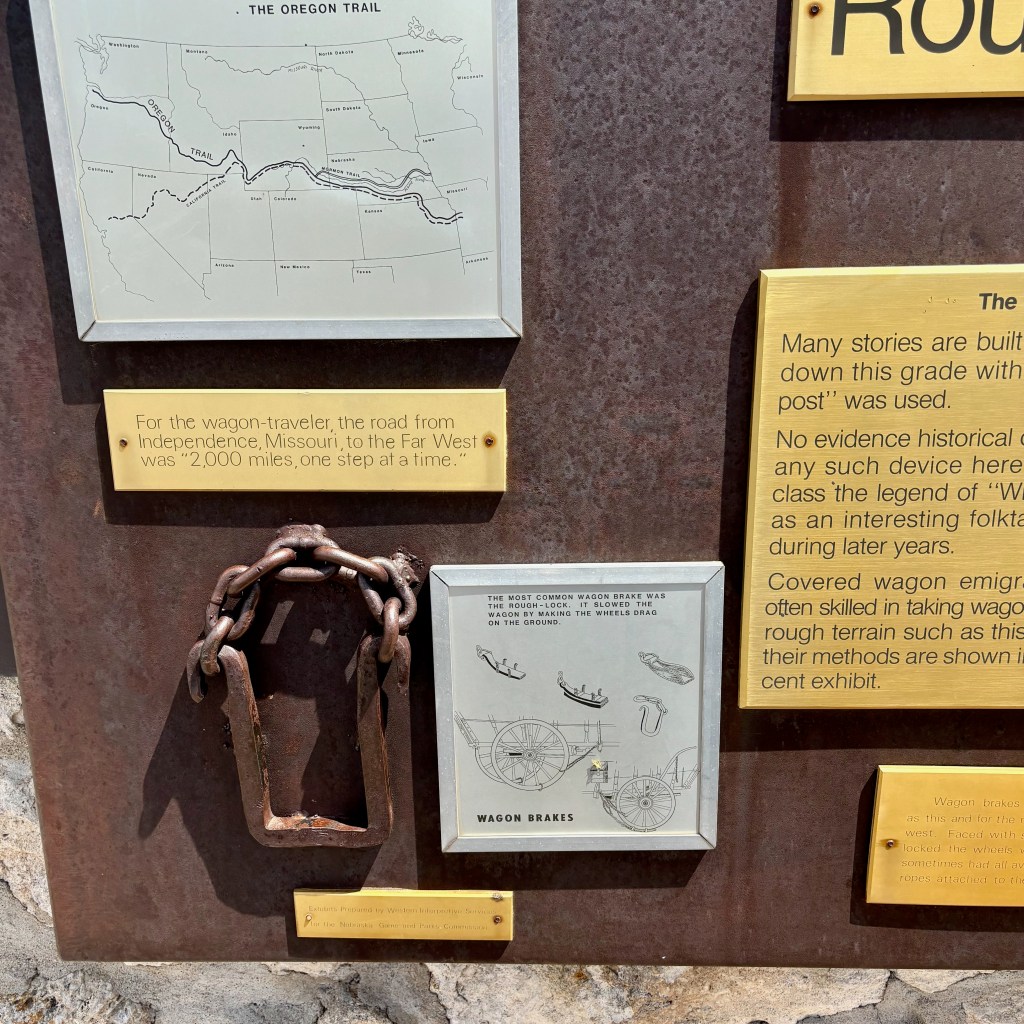
And then there’s this. You’ll need rough locks (below, lower left), if you’re heading down the death-defying incline now known as Windlass Hill. It didn’t get its evocative name until decades later. In 1849, it was known as “Perpendicular Hill.” We climbed it, and I have to say, that’s accurate. It’s terrifying, even on foot. Pioneers used rope, brawn and rough locks to brace their wagon wheels for the trip down. Then they skidded their fully-loaded wagons down the 240-foot drop. My heart falters at the very thought. One last word: The “no evidence… any such device” reference in that yellow square (bottom right) is about windlasses. Lore has it that pioneers must have used an actual windlass or wrapped ropes around trees to slow their wagons’ descent, but there’s no historical evidence of that. Those bold emigrants used sheer muscle and oxen power.


Leave a Reply