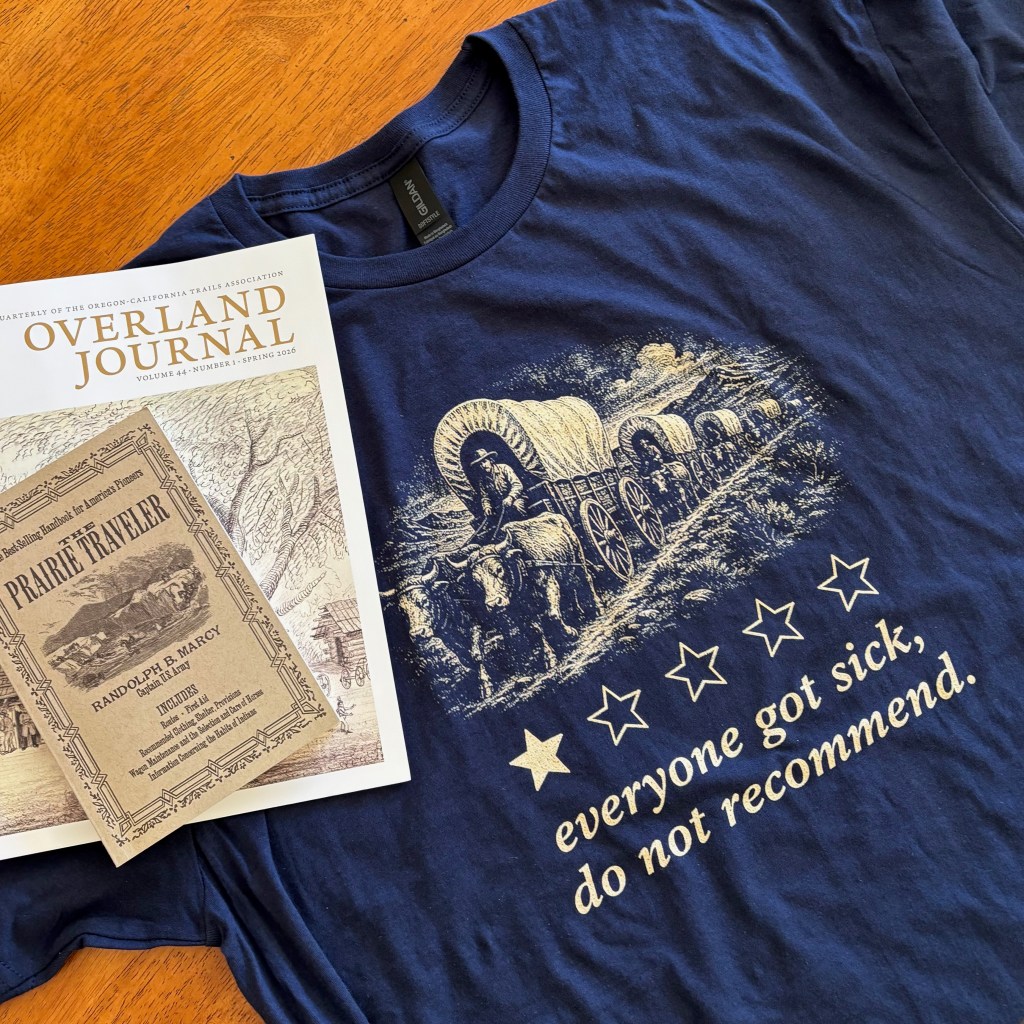
I love history humor, and my algorithm knows it. Instagram keeps offering up a Pompeii Fun Run T-shirt, complete with mosaic depiction of panicky people fleeing the erupting volcano. So dark! It might be an effective history teaching tool, though. You’ll never forget the year Vesuvius erupted after seeing 79 A.D. spelled out in mosaic tiles. Even Etsy seems to have entire pages devoted to “T-shirts for history teachers,” as if Ms. Frizzle hadn’t inspired enough academic wardrobe cleverness already. It’s a whole Frizzle wannabe genre.
But this one. This. One. ☝️
I’m wearing this Oregon Trail Yelp/Tripadvisor review as I read Randolph B. Marcy‘s “The Prairie Traveler,” an 1859 best-seller aimed at westward-bound emigrants and based on the U.S. Army captain’s epic overland journeys during the 1850s. He doesn’t tout himself, but reading about his accomplishments elsewhere, his explorations of Indian lands, his discoveries of new species of wildlife — new to us, anyway — and the source of the Red River, it’s stunning to imagine this intrepid man’s travels. He criss-crossed the continent multiple times, strode into potentially perilous places, met people everywhere he went and forged lasting bonds, all while taking care of his own men.
Some of his feats were unheroic by modern standards, of course. We do not wage war against Seminoles, and battling Mormons is very much frowned upon these days. But that’s the thing about history. Things look VERY different 100 or 1,000 years out. We’d like to think we’re getting better as a civilization, but prejudices wax and wane, greed conquers good intentions, and we, as a species, are damn forgetful about really important things. Survival things.
Folks, we humans have forgotten how to cure scurvy at least seven times since Ancient Egyptians jotted it down — eat onions and fresh vegetables — on papyrus in 1550 BCE. Just because you popped a nice, tart Vitamin C gummy this morning doesn’t mean your descendants will do the same in 2150. They may be too busy trying to cure some strange horrible illness that — surprise! — makes your teeth fall out, blood vessels leak and old injuries re-emerge. (And if your reaction to the Vitamin C reference is “Wait, what? I take it, so I don’t get sick.” That’s the sickness. Scurvy. We’ve forgotten already.)
Where were we? Oh right! Diseases on the Oregon Trail — 1 out 5, do not recommend — and Marcy’s marvelous book. It offers the nuts and bolts of trail travel, including the need to rivet the ends of your bolts, especially the ones securing your wagon’s running gear, because nuts fall off. Wondering whether to take oxen or mules? (Oxen for the prairie, mules for town.) Which path and when? Which supplies and what quantity? How do you ford a river? How do you organize a wagon company? How do you jerk meat or repair a lariat? And how do you survive? By helping each other. That’s how.
It’s all there in practical, reassuring detail, complete with occasional dry, amusing asides. It’s a product of its time, a period when native tribes were being pushed from their ancestral lands, and emigrants — primarily white men seeking California gold and free Oregon farmland — were swarming across the continent by the hundreds of thousands. But some of it is ahead of its time. The idea of purifying water by boiling it and avoiding “water taken from stagnant pools charged with putrid vegetable matter and animalculae” — protozoa and bacteria — predates germ theory by decades. And there is wisdom in here that applies now:
“On long and arduous expeditions men are apt to become irritable and ill-natured… That man who exercises the greatest forbearance under such circumstances, who is cheerful, slow to take up quarrels and endeavors to reconcile difficulties among his companions, is deserving of all praise and will, without doubt, contribute largely to the success and comfort of an expedition.” — Randolph B. Marcy
In other words: When the going gets rough, be nice. Take care of each other. And take your vitamins.


Leave a comment